Whole School Literacy
Literacy
Ensuring that students develop their ability to read confidently, critically and with empathy is the starting point for our approach to literacy, to enable students to access the curriculum and develop the essential life skills they need. Excellent reading skills support students in accessing information and understanding ideas that empower them and open doors of opportunity. Reading widely supports students in exploring worlds similar and vastly different to their own, and encourages them to imagine, to empathise and to consider the world from somebody else’s point of view. The vital importance of clarity, accuracy and effectiveness in communicating orally and in writing also underpin literacy across the curriculum.
Reading
In lessons, reading tasks equip students with strategies that enable them to retrieve, summarise and synthesise information; draw inferences; explore a viewpoint; analyse and evaluate ideas; and read for a range of purposes. In English lessons, where exploration and analysis of whole texts is at the centre of each term’s unit of work, students are provided with wider reading lists for each key stage to encourage them to read widely. Similarly, suggestions for subject-specific wider reading, including the reading of secondary sources, are provided by subject areas across the curriculum. In addition, the whole-school reading projects - Sixteen before 16 and the Key Stage Five Reading Challenge, help to foster a life-long love of reading, as well as challenge students to explore different literary forms and styles in a structured way.
Sixteen before 16 is a list of books, compiled from nominations from all subject areas, that are not taught or examined but we think all students should read and they are challenged to do so before they are 16. Winners of the Nobel Prize for Literature, the Carnegie medal and the Pulitzer prize feature on the list. It covers a vast range of themes, including: hope, love, deception, loss, growing up, conflict, choice, inequality, courage, poverty and power. The books present a wide variety of literary styles including: satire, fables, modern memoirs, gothic literature and magic realism. Reading these texts transports students to different times and locations, including Hardy’s Wessex, America in the 1930s and post 9/11, Auschwitz 1944, the rural Punjab, Wolverhampton, London and Nigeria.
Students are able to access a whole-school Google Classroom for reading through which they can view PowerPoint presentations on each of the texts on the list. These introduce the book, provide extracts from it to provide a flavour of the text, provide links to trailers or clips of the film version of the text where this is available, quote reviews of it by our students and offer suggestions of other books by the same author or exploring similar themes and issues. The list is regularly reviewed and changes are made periodically. Students are encouraged to discuss what they are reading with their parents and carers at home and to facilitate this, the sixteenth spot on the Sixteen before 16 list is for a parent’s/carer’s recommendation.
16 Before Sixteen Reading List - click here

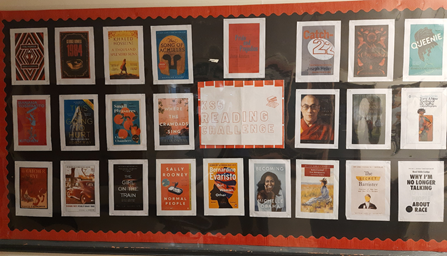
The Key Stage Five Reading Challenge is based on a list of books recommended by members of staff across the curriculum and previous sixth-form students. It is organised into a number of categories, including non-fiction and historical fiction, and covers a range of eras, writers, themes and literary styles, to enthuse students to keep reading and to encourage reflection on the human condition. Students are encouraged to peruse the list and set their own reading challenge, for example, to read three books from each category by the end of the academic year.
The school library (including the online library, Accessit) supports these whole-school reading projects and runs a range of activities to support students’ reading. The school’s book club meets every Friday in the library, with students often taking opportunities to lead it. The library organises visits to DGGS by authors such as Julian Sedgwick, whose work features on the Sixteen before 16 list and encourages cross-curricular links with Ethics, Geography and Art. The library’s participation in the Carnegie shadowing scheme and theatre trips organised by the Drama department and English faculty provide further opportunities for students to enjoy reading and exploring texts. Students can also explore the presentation of stories through the weekly film club and there is an opportunity to consider media and digital literacy in one of the form-time literacy activities that students complete throughout the school year.
Key Stage 5 Reading Challenge List - click here
Speaking and Listening (Oracy)
Discussion of texts is just one way in which students are supported and encouraged to develop their speaking and listening skills across the curriculum. ‘Think/Pair/Share’ is a regular feature of lessons in all subject areas, enabling students to clarify, develop and reflect upon their thinking and learning via structured and accountable talk. Students are supported and challenged to use specialist, precise and nuanced vocabulary in their spoken communication, whilst also employing the key vocabulary explicitly taught in all subjects. Class discussions support oracy through the use of ‘Agree/Build/Challenge’ which also helps students to develop their listening skills. Twice-termly form-time literacy activities provide further opportunities for students to debate a range of motions, developing their critical thinking skills and ability to create and communicate logical arguments clearly and persuasively, whilst listening carefully and respectfully to the views of others. Students are also encouraged to attend debating club and participate in public speaking competitions. Discussions of current events and news items at home with parents and carers can also help students to develop confidence and clarity in their spoken communication.
Writing
Across the curriculum, students are taught to write in different forms and for different purposes, following the appropriate conventions and writing to time. Strategies such as the use of Cornell notes support students to develop key skills such as effective note-making. Key vocabulary lists in every subject are explicitly taught (through strategies such as the Frayer model which secures understanding of words through considering antonyms and synonyms) and are frequently revisited. Students are taught new vocabulary in context, considering etymology and morphology. Literacy activities in form-time each term revisit key vocabulary across the curriculum and key aspects of punctuation and grammar, encouraging students to transfer skills taught in English to all subjects and all aspects of their written communication, emphasising the absolute importance of clarity, structure and technical accuracy. All students have access to a Google Classroom for writing skills with resources to support their understanding of aspects of punctuation, grammar, vocabulary and formal academic writing. The assessment of spelling, punctation and grammar is supported by the school’s assessment policy. Students are encouraged to attend the school’s creative writing club and poetry club to have further opportunities to enjoy writing creatively. The lower school weekly spelling bee, Poetry by Heart and the summer inter-house Scrabble competition support students to develop their skills in a competitive but fun way. Parents and carers encouraging students to learn spellings and vocabulary regularly at home is also immensely valuable.
Additional Support
In addition to in-class interventions, one-to-one and small group additional support sessions run at lunch-time and after school to help students to strengthen their literacy skills. Following referrals by their English teachers, students are invited to attend and attendance is monitored. Parents and carers are notified via an emailed letter and their support in encouraging students to attend is greatly appreciated. All students have access to an English Independent Learning Google Classroom for their year group, where they can develop their reading and writing skills through completing the tasks posted weekly on which they can receive feedback.
How parents/carers can help to support students’ literacy:
Reading:
- Discuss Sixteen before 16 with your daughter/son and provide a recommendation for the sixteenth text.
- Encourage your daughter/son to read widely, exploring the work of different authors (use the relevant key stage wider reading list issued in English lessons and the Key Stage Five Reading Challenge booklet issued by form tutors to assist with this; the books on these lists can all be found in the school library).
- Discuss with your daughter/son the characters and themes in the books she/he is reading; encourage them to compare texts.
- Provide access to national newspapers regularly and encourage your daughter/son to read articles, editorials and the work of columnists.
Speaking & listening:
- Discuss appropriate stories, current affairs and issues in the news, encouraging consideration of opposing views.
- Encourage your daughter/son to construct logical arguments in debates and to think critically in order to see the strengths and flaws in arguments.
- Encourage your daughter/son to communicate verbally with clarity, appropriate expression and nuanced vocabulary.
- Encourage her/him to listen carefully, respectfully and critically to the views of others.
Writing:
- In KS3, test your daughter on the spellings and definitions of the words she is learning for her spelling/vocabulary tests.
- Encourage your daughter/son to write accurately at all times and to proof-read what she/he writes.
- Encourage her/him to write for different purposes (such as to clarify thinking and to support independent learning), to write formally when required and as a creative pursuit.